Gag Order
Proscription is bad for democracy - and harms our national security, argue Lee Jarvis and Tim Legrand
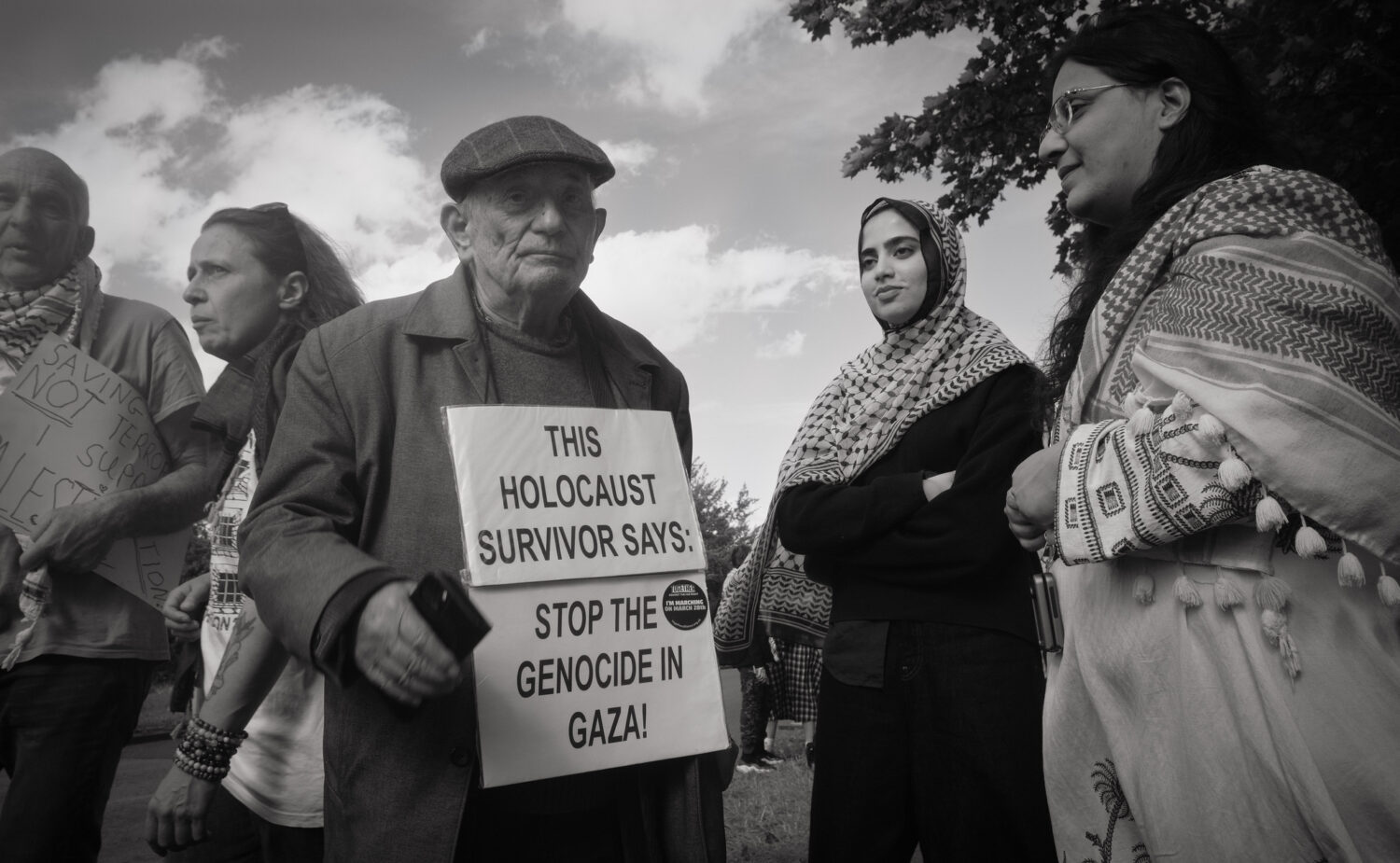
These are testing times for liberal democracy in Britain. A succession of global political challenges – climate change, overseas conflicts, irregular migration, and beyond – have generated strident domestic political movements demanding wholesale policy change.
The sight of clamorous and sometimes brash political protests feels like a reprimand to political scientists who not so long ago characterised our era as a time of ‘anti-politics’.
Without question, the most controversial of the state’s responses to contemporary protest movements has been the proscription of Palestine Action as a terrorist organisation last August. The government argued that its use of “direct criminal action tactics” achieved “serious damage to property”, meeting the threshold of terrorism activity and thereby warranting proscription of the movement.
Around 700 people have since been charged under the Terrorism Act 2000 for supporting or being a member of Palestine Action. They face potentially lengthy prison sentences.
About proscription
In 2019, we wrote Banning Them, Securing Us?, which set out the UK’s uses of proscription as a tool of colonial repression, national security, and anti-terrorism.
It is remarkable how little proscription has changed since the mid-18th century, when the Act of Proscription 1746 proscribed the Jacobite movement, banning the wearing of kilts and tartans and enforcing loyalty tests on teachers to ensure ‘rebellious principles were not taught in schools’.
The centuries since have seen successive governments revising and applying related powers against identified threats. In overseas territories, colonial administrators outlawed or denied legal status to organisations opposing British imperialism, while – closer to home – violence in Ireland saw republican and loyalist groups outlawed as terrorist, including the IRA, UFF, and Red Hand Commando.
Today’s power to proscribe terrorist organisations is contained in the Terrorism Act 2000.
Under section 3 of the act, the home secretary can order the proscription of an organisation – expansively defined as ‘any association or combination of persons’ – if she ‘believes that it is concerned in terrorism’, including committing or participating in acts of terrorism; promoting or encouraging terrorism; or even expressing ‘an opinion or belief’ supportive of a proscribed group.
While the home secretary alone can make an order for groups to be designated as terrorist organisations, an order must receive parliamentary assent to take effect.
Proscription immediately generates a host of terrorist offences. It becomes an offence to be a member of the outlawed group; to recruit members; to give or invite support; or to display in public a flag or ‘article’, or to wear clothing, associated with a banned group.
In November 2024, police arrested musician Mo Chara, real name Liam Óg Ó hAnnaidh, of the Irish band Kneecap for allegedly displaying a flag associated with the proscribed group Hizballah. The case against him was subsequently dismissed.
Speech in public that supports an outlawed group also becomes an offence, including ‘glorification’ and ‘support’. Petitions, songs, placards, flags, banners, clothing, and more all fall under these provisions.
It was on these grounds, for example, that Hizb ut-Tahrir was proscribed in the UK in 2024 after its promotion and encouragement of terrorism in relation to the 2023 Hamas attacks.
Today, 98 organisations are proscribed in the UK as terrorist groups, including 14 in Northern Ireland under previous legislation.
Since 2000, the home secretary has made 32 proscription orders outlawing 84 groups, and parliament has never resisted any order. Related powers have also recently been used to prohibit support for Iran’s Islamic Revolutionary Guard Corps (IRGC) and two other state-based entities linked to antisemitic and other violences in the UK.
Problems with proscription
Few dispute that proscription represents a significant intrusion on liberal democratic values. It is surely, as home secretaries have intoned in parliament, a ‘severe’ tool, even for those who deem the power necessary for preventing, deterring or disrupting terrorism.
Proscription’s intended impact is, fundamentally, a normative one: it allows governments to signal the illegitimacy of particular organisations, and in the process, to set out and patrol the parameters of acceptable political association and speech.
Proscription also strengthens the capability of policing agencies to diminish a group’s capabilities, for example by impeding material support, imprisoning post-proscription members, and seizing assets.
Whatever its political and practical usefulness, few counterterrorism tools have attracted as much sustained criticism within academia and civil society as proscription. Four prominent concerns are especially relevant today.
1. Proscription undermines democracy
The decision-making and approval processes of proscription mean it is bad for democracy.
Proscription might be seen as the antipode of modern democratic values: the power to outlaw a political movement is in the primary control of an individual home secretary. This concentration of power creates risks of arbitrary or partisan motives intruding on the perimeters of legitimate political speech and association.
2. Parliamentary scrutiny is limited
While parliament plays its role in assenting to a proscription order, there are poor prospects for meaningful challenge.
A longstanding cross-party consensus on national security diminishes meaningful scrutiny of the home secretary, rendering parliamentary debate little more than a ritualistic performance. Intelligence assessments supporting a home secretary’s decision-making, for instance, are not released to MPs prior to their vote.
Relatedly, an idiosyncrasy of procedural rules enables home secretaries to bundle multiple groups into single proscription orders. Doing so may be expedient for government but forecloses parliament’s scope for resisting individual cases, since assent must be given en masse.
In March 2001, for example, the home secretary ordered 21 groups to be proscribed as terrorist organisations, many unknown and never previously mentioned in parliament, prompting Lord McNally to object:
“By any standard of natural justice, that does not make sense. It means that the good, the bad and the ugly are put together”.
More recently, the order to proscribe Palestine Action also included the ‘Maniacs Murder Cult’ and ‘the Russian Imperial Movement’. The move was declaimed in the Commons by Pete Wishart of the SNP as “a cynical and calculated move by the government”, and by the independent MP Shockat Adam as “a reckless abuse of process”.
3. Proscription threatens civil liberties
Proscription intrudes on freedoms of speech, association, and protest.
Effective political action is often – by design – disruptive, disobedient or direct. Indeed, protest sometimes breaks the law, with imprisonment the price willingly paid by activists campaigning for animal rights and women’s suffrage, against nuclear weapons, and, in recent years, for action on climate change.
Despite those individual convictions, many political movements have endured and, indeed, prevailed.
Today’s Terrorism Act, however, grants home secretaries extraordinary latitude in determining who or what constitutes terrorism. Political demonstration might be construed as intimidation of a government; advocacy as glorification of terrorism; and direct action as terrorist violence.
These concerns are not the preserve of civil liberties advocates or academic researchers. The parliamentary debate on the proscription of Palestine Action saw Clive Lewis MP argue that the group was engaged in “direct action, not terrorist action”.
4. Proscription may undermine national security
Proscription is also potentially bad for national security, because it is rooted in an unhelpful way of thinking about terrorism.
Central to the power is the idea that terrorism is an identity, not an action: something groups and their members are, not something they do.
This dramatically expands the remit of terrorism, with implications for resource allocation at home and peace processes overseas.
The rarity of de-proscription in the UK, moreover, means that its list of proscribed organisations reflects historical security concerns which are potentially no longer relevant and risks an inaccurate impression of contemporary threats.
Linked here is the risk that proscription may create perverse security outcomes. It may generate notoriety for otherwise-anonymous groups – who reading this had previously heard of the Maniacs Murder Cult? – or promote public sympathy or support.
Final thoughts
Nothing we have written here, or elsewhere, indicates support for any proscribed organisation: groups included on the UK’s list are responsible for violent actions and campaigns that should be described, and condemned, as abhorrent.
That we finish this essay – as academics working on terrorist listing for over a decade – by making this clear is, perhaps, telling of proscription’s potentially chilling power.
At the same time, we worry about the awfulness of terrorist outrages – from 9/11 and 7/7 to more recent tragedies including the 7 October 2023 massacre in Israel and the 2025 attack on Sydney’s Jewish community – insulating counterterrorism powers, including proscription, from criticism or challenge.
Indeed, beyond the concerns noted above, let us finish by offering three reasons we should be especially attentive to the working of political power in this field.
First, counterterrorism decisions often outlive their rationale and anticipated timeframe. We should, therefore, be attentive to the future harms of well-meaning contemporary decisions.
Second, counterterrorism powers often enjoy an expansive logic – tending to grow rather than contract over time – evident, in this case, with the ever-increasing list of designated organisations in the UK.
Third, the arena of counterterrorism is so suffused with suffering and anger that deference – to government, but also to victims of violence – often (understandably) trumps critical reflection.
Yet, reflection on the limits of political authority is, ultimately, a far greater guarantor of liberty and security than a politics of exceptionalism risked by proscription regimes in the UK and beyond.