Fear and Loathing in Britain
Populist forces have divided Britain, but far more binds us together, writes Jeevun Sandher MP
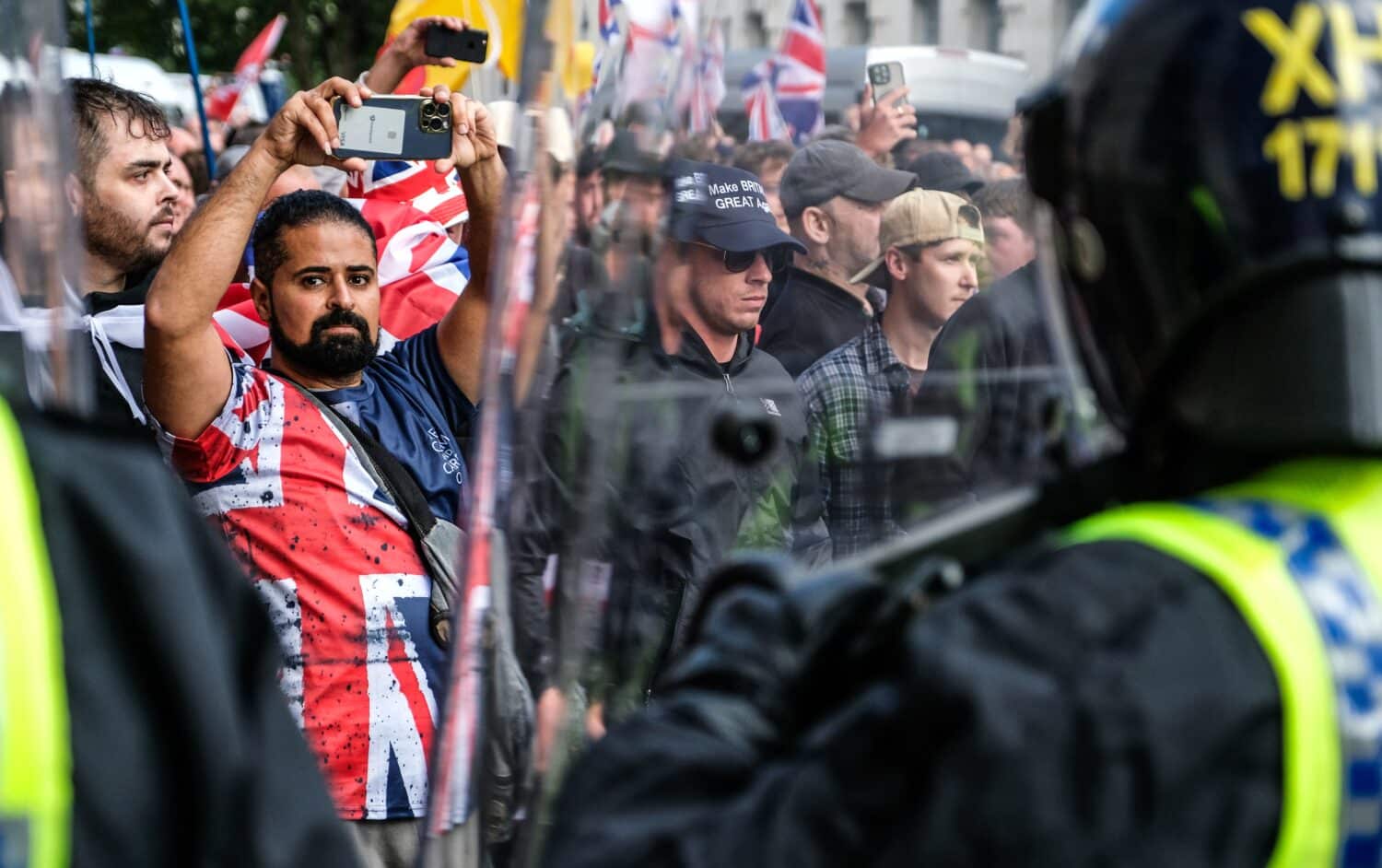
Developing a notion of Britishness that brings people together is the defining political challenge of our time. Britain’s divides are growing to dangerous levels as our radical opponents seek to exploit people’s fears and divide the British people into ‘us’ and ‘thems’.
These divides are growing. Some of us can afford to live a good life, while others cannot. Some of us are moving to cities, while others stay put. Some of us live within our communities, while others find community online. Economic anxiety, geographic divides, and online anger are making people feel that their way of life, and that of their children, is being threatened. Those on the political extremes seek to exploit this fear and widen our divisions. Easier than the real explanation, our problems are painted by others as the fault of either immigrants or big business – those thems.
To overcome this fear and unite our nation, we need both a policy and a political answer. We need to ensure every single person in this country can live a good life and unite under a common notion of Britishness – building on our strengths as one of the most trusting and least racist nations on earth. A Britishness that celebrates the decency, unity and determination that defines us.
Fear, anger, and mutual suspicion are growing as more and more Brits feel their way of life, and that of their children, is fundamentally threatened. When people are asked to describe how they feel about their children’s future, the top five answers are: worried, uncertain, frustrated, conflicted, and angry. That anxiety and fear is leading to a deep desire for people to hunker down and protect those closest to them by seeking safety in a group. We all live in such groups, but the danger is that different groups are increasingly being pitted against one another within our nation. Rather than viewing our group as a different part of the same whole, people are increasingly fearful of others.
Human beings are naturally groupish. We sort the world into ‘us’ and ‘thems’.[1] Being able to relate to a broad ‘us’, which includes those beyond our immediate kin and friends, is the driving force behind human civilisation. It is why Britain has achieved remarkable things in our history: from pioneering the industrial revolution to protecting democracy in Europe. Throughout our history, our greatest moments have been founded in a collective British ‘us’ that includes all of us. Consider the Covid-19 pandemic, for example, when we sacrificed our own wellbeing to protect the lives of perfect strangers. We overcame seemingly impossible changes by standing together, rooted in common concerns, interests, and connections to one another.
The danger for the UK, and other high-income nations today, is that deep in group-out group divides are opening up. Our notion of Britishness is being undermined by radical parties dividing us into the ‘real’ British us and any number of un-British thems who are the source of all our problems.
A unified sense of what it means to be British is decaying because our experiences, information, and emotional outlook differ wildly. We are divided economically, geographically, and culturally, which is leading us to experience and feel about our country very differently. The feeling that there are those who can get on in life and those who cannot is leading to rising mistrust and division.
Wealth and the number of billionaires is rising while record numbers cannot afford the basics, and half believe the cost-of-living will never end. We are increasingly segregated by where we live, with graduates moving to work in major cities while their non-graduate counterparts remain near the place they were born. We spend, on average, more than two-and-a-half hours scrolling in different online spaces, increasingly engaging only with algorithms designed to keep us in echo chambers. This is causing loneliness to rise, which in turn leads to a deep desire to be a part of a group – an us – that can protect us in difficult times.
Seeking security, connection, and certainty from belonging to a group is a powerful psychological instinct that goes into overdrive when people feel their way of life is threatened. Hannah Arendt wrote powerfully about how these instincts helped to drive and fuel radical political movements.[2]
Today, these threats include both falling economic prospects and the social exclusion that comes with rising inequality. When the gap between the rich and poor widens, every person in society becomes more stressed and less trusting of others.[3] Cooperation falls as people understand and interact with each other [4] less and less. At the same time, many people are also seeing their economic prospects decline rapidly. People who were previously getting on just fine decades ago – or saw their parents doing so – are no longer. These people, often against the backdrop of insecure economic and social lives, then seek a sense of connection, security, and certainty within a group. The groups catering to the psychological needs of the economically and socially insecure are those that provide security and certainty by defining all the threats to one’s life as due to another group: those un-British ‘thems’ over there. This has a perverse psychological benefit: people feel less stressed when coalescing around a common enemy or when they scapegoat those with less social status[5].Punching down can, unfortunately, be a cathartic way to make sense of the world, as well as a form of self-protection when one’s position in society is threatened.
On top of this deep and widening divide, people are finding the present and future an increasingly scary place. Around 80 per cent think the world is more dangerous today, while 75 per cent feel the government has little control over it. Around three-quarters of the population feel that Britain’s best days are behind it, while half feel that the next generation will have a worse future than their parents. Put all this together, and when looking at the future, rather than feeling hope, excitement, or contentment, people are feeling fear and anxiety.
We must meet the fear, anxiety, division, and uncertainty that defines our moment. Understanding why people have such a deep desire for change and why, as a nation, we understand each other less and less. Radical voters, who feel more threatened than the rest, are drawn towards strong leaders who promise to fix things with a vision of what Britian could be. We need a policy answer which makes it possible for everyone to live a good life and a political answer based on a notion of Britishness that celebrates the decency, unity and determination that defines Britain at its best.
In Britain and other high-income nations today, it is hard to explain the forces that are making some of us far poorer than others. This is why simple populist rhetoric has such a powerful and pernicious hold. As Labour Together found in their research on the cost-of living crisis: “Voters cannot understand how a crisis on this scale could have happened in a country that was supposed to be one of the wealthiest in the world.” This echoes the 1930s, when a hard-to-explain financial crisis made some people far poorer and led to rising division, anger, and radical voting. By contrast, when the pandemic struck in 2020, and during the second world war, Britain pulled together as one people, fighting against a common enemy. Today, in 2025, we are again combatting hard-to-explain, impersonal economic forces which are hitting some more than others, leaving us with little sense of Britain’s collective struggle.
The radical fringes on both sides of politics are feeding on this lack of collective identity to widen Britain’s divides. They are helping those who cannot afford a decent life to view the world through a prism of the threatened “us” vs. comfortable “thems.” Unlike mainstream voters who are relatively well off, voters that are likely to support radical parties believe life was more affordable 30 years ago and that their way of life is threatened. On the one hand, Nigel Farage tells us that “mass migration is making us poorer in every single way”; on the other, Jeremy Corbyn and Zarah Sultana argue that “the problems in our society are caused by… corporations and billionaires.” They provide a simple and emotionally compelling answer to incredibly complex issues. This is dangerous, divisive, and wrong. It is not a case of ‘us’ vs ‘them,’ but a collective British struggle to meet this moment, standing together, united.
There is a gap for defining a notion of Britishness that brings us together rather than drives us apart. A vision that builds a British identity based on our strengths, not our weaknesses. When asked what it means to be British, strong and growing numbers believe it is what we do (eg, to respect British institutions or have citizenship), rather than how we are born. There is a way of defining our nation that pulls everyone into a common us.
The Britishness I know is not divisive. Radical politicians do not espouse majority views, nor do they live up to the greatest traditions of this nation. Rather than being proud of our country, they do it down. We are not the thugs Farage sought to excuse in last years protests; as Orwell put it: “the gentleness of the English [is our] most marked characteristic.”[6]
If we want this nation to succeed in the most dangerous and violent time this country has known in over a century, then our political project must ensure every person in Britain can live a decent life within a vision of Britain that unites us. This runs through our policy and our politics. Our policies must ensure that everyone can live a decent life, connect us more with one another, and reduce the violent divisions that begin in echo chambers. Our politics must provide an emotionally compelling vision of Britishness that draws everyone in, regardless of their background. A Britishness that encapsulates the unity, decency, and determination of our nation. A Britishness that is proud of our greatest traditions and history as well as those small everyday moments that make us who we are: politely queuing, a cup of tea, and even a cheeky pint. A Britishness that lives up to our greatest traditions by creating a better future for each and every one of us.
Image credit: Victor Allen via Flickr