Finding the middle ground
The public are seeking a middle ground on migration, balancing control with shared values and contribution, finds Ben Cooper

Immigration and asylum remain a dominant topic in British politics. Below, we present analysis of fresh new polling which shows what the public really thinks – and on how the new prime minister is faring.
Not just a niche issue
Our new polling with YouGov found 51 per cent of respondents selected immigration and asylum as one of the most important issues facing the country.[i] It was the joint most selected issue alongside the economy. Around a third (37 per cent) of Labour’s 2024 voters selected immigration and asylum – making it the second most selected behind the economy (see figure 1).
Figure 1: Britons consider immigration and asylum to be one of the biggest issues facing the country.
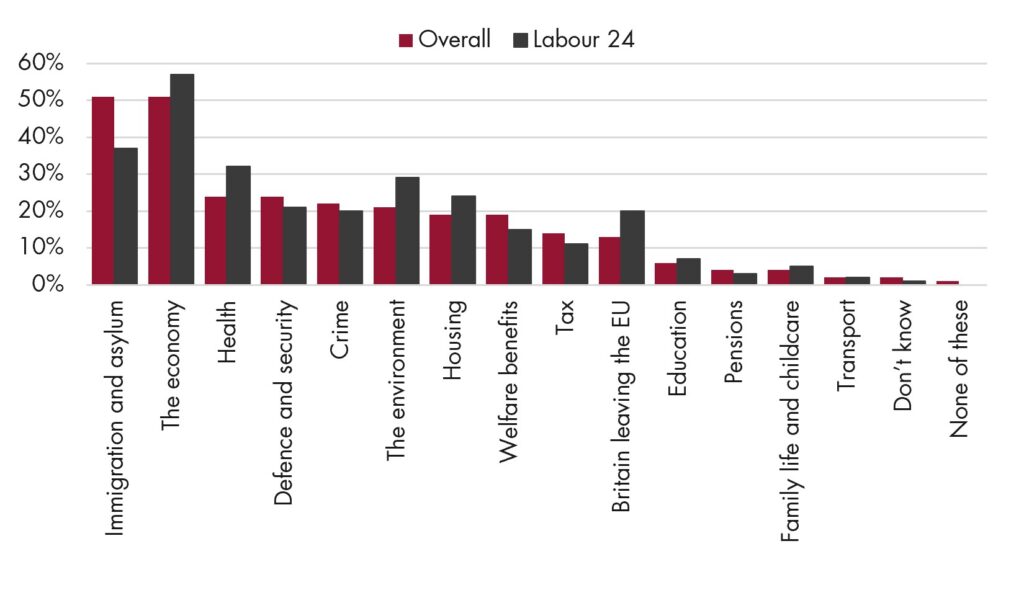
Question: Which of the following do you think are the most important issues facing THE COUNTRY at this time? Please tick up to three.
Since being elected, the government has made significant progress in cutting migration numbers and tackling illegal channel crossings. Official statistics state that net migration fell by 48 per cent in 2025 compared to the year before. Small boat arrivals have dropped 11 per cent compared to when Labour took office – reaching the lowest level since 2021.[i]
Despite this progress, there is significant dissatisfaction with the government’s handling of immigration.
- 61 per cent of respondents said they were either ‘very dissatisfied’ or ‘somewhat dissatisfied’ with the way the government has handled the issue.
- 13 per cent saying they are either ‘very satisfied’ or ‘somewhat satisfied’.
- 19 per cent said they were ‘neither satisfied nor dissatisfied’ – and 7 per cent said don’t know.
Of those who said they are dissatisfied:
- 21 per cent said the best reason for this was the government ‘not doing enough to stop channel crossings’.
- 18 per cent said ‘not enough illegal migrants are being removed from the country’.
- 15 per cent selected ‘immigration numbers are too high’.
Very few respondents were concerned that the government’s policy was too strict. Just 5 per cent said the best reason for their dissatisfaction was ‘creating a negative and fearful environment for migrants who live in Britain’, while a further 5 per cent said ‘the government has failed to tackle disinformation about migration’ (see figure 3).
This suggests more respondents are concerned about a perceived lack of control over the borders and tackling illegal migration.
Labour voters want tougher policy as well
Even Labour voters are dissatisfied with migration policy. Commentators have commonly portrayed the government’s migration policy as pandering to Reform voters. However, we find dissatisfaction among Labour’s 2024 voters too:
- 44 per cent of respondents who voted Labour in 2024 are either very or somewhat dissatisfied.
- 27 per cent are either very or somewhat satisfied.
- 23 per cent are neither satisfied nor dissatisfied – and 7 per cent said don’t know (see figure 2).
Figure 2: A majority of respondents were dissatisfied about the government’s handling of immigration.
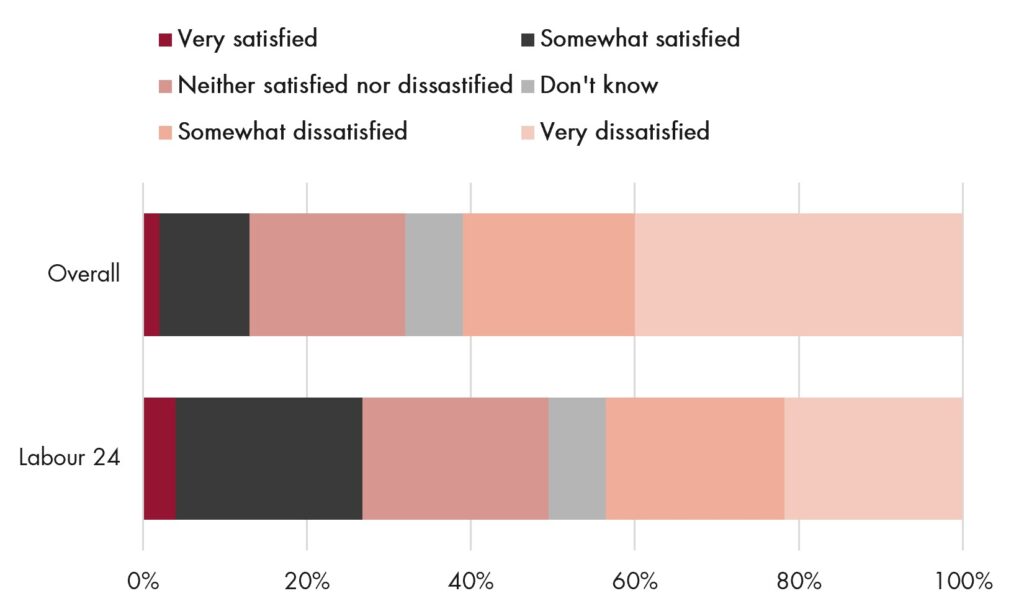
Question: Overall, how satisfied or dissatisfied are you with the way the current government is handling immigration?
These voters were not dissatisfied because government policy is too tough, as figure 3 below shows. For Labour 2024 respondents who were dissatisfied:
- 17 per cent were dissatisfied because not enough illegal migrants are being removed from the country (the most selected reason).
- 16 per cent selected immigration numbers are too high.
- 14 per cent said both not doing enough to stop channel migrant crossings and allowing too many people to claim asylum in Britain.
- 9 per cent were dissatisfied because they thought the government had failed to tackle disinformation about migration.
- 5 per cent thought the government had created a negative and fearful environment for migrants who live in Britain.
Figure 3: Dissatisfied Labour 2024 voters were most likely to select not enough illegal migrants being removed.
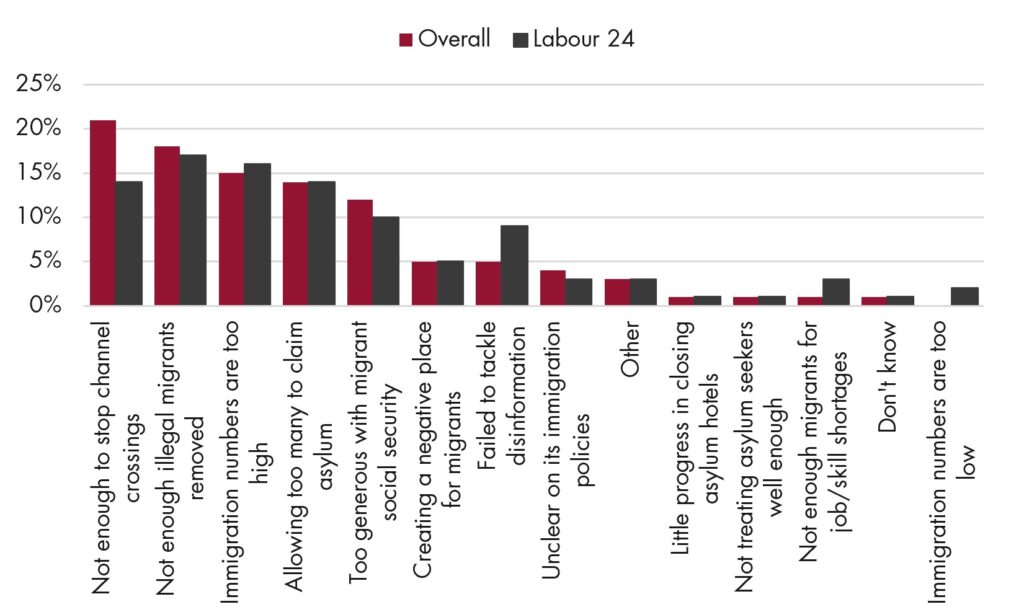
Question: Which of the following BEST describes your reason for being dissatisfied with how the current government is handling immigration? Asked among those who say they are dissatisfied with how the current government is handling immigration
Andy Burnham is the most trusted compared to others
While many voters are dissatisfied with the government over migration, the prime minister has the opportunity to build trust on immigration and asylum policy. Andy Burnham has a stronger trust profile compared to Nigel Farage.
Among all respondents:
- 24 per cent trust Andy Burnham on immigration and asylum – compared to 40 per cent who do not trust him (net -16 per cent).[i]
- 21 per cent trust Nigel Farage on immigration and asylum – compared to 61 per cent who do not trust him (net -40 per cent).
For Labour 2024 voters:
- 47 per cent trust Andy Burnham on immigration and asylum – compared to 18 per cent who do not trust him (+29 per cent).
- 11 per cent trust Nigel Farage on immigration and asylum – compared to 78 per cent who do not trust him (-67 per cent).
For voters, control matters and not just cutting numbers
Our survey also asked respondents what should matter most in the migration system, and how the government should reform it. They clearly prioritised control and contribution, over a focus on cutting overall migration.
When asked what the single main principle of the migration system should be:
- 29 per cent of respondents picked ‘stopping illegal migration and removing those who have no right to be here should be the overwhelming priority’.
- 15 per cent said ‘those who want to live in the UK should be expected to abide by British values and laws, including gender equality, tolerance for LGBT rights and mutual respect’.
- 9 per cent selected ‘we should be a place of sanctuary, always prepared to help those fleeing their home to escape war, conflict or persecution’.
- 6 per cent chose ‘there should be a significant reduction in the number of people coming to the UK’.
Figure 4: The most popular principle for the migration system is stopping illegal migration and ensuring people abide by the rules.
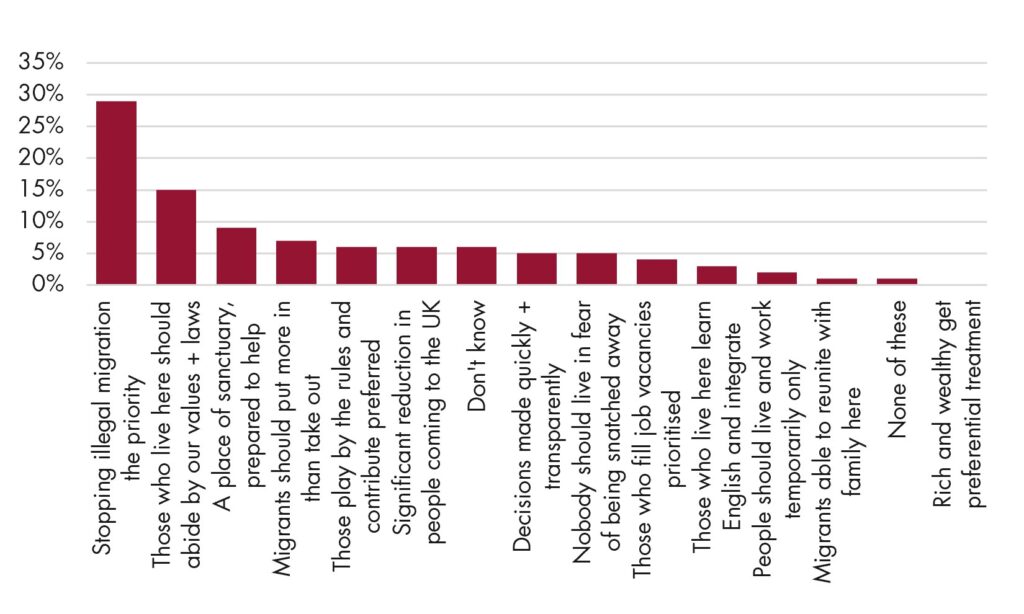
Question: We are going to show you a series of principles for how the government COULD manage the migration system. Which of the following should be the main principle for how the government should manage the migration system? Please select one option.
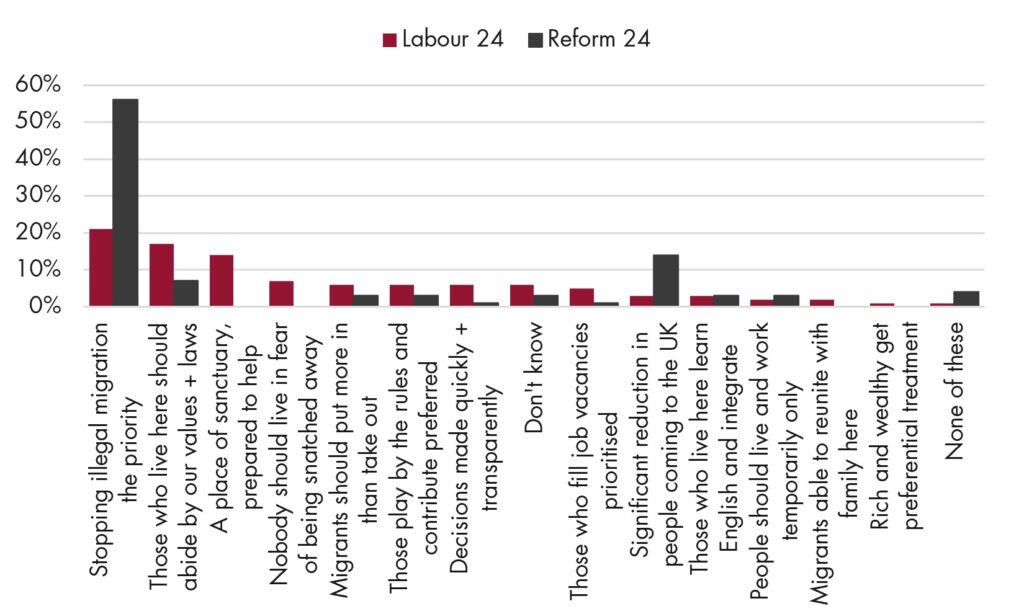
Labour 2024 voters strongly support the idea of migration policy focusing on control. When asked the above question about the main principle of the migration system:
- 21 per cent choose ‘stopping illegal migration and removing those who have no right to be here should be the overwhelming priority’.
- 17 per cent said ‘those who want to live in the UK should be expected to abide by British values and laws, including gender equality, tolerance for LGBT rights and mutual respect’.
- 14 per cent selected ‘we should be a place of sanctuary, always prepared to help those fleeing their home to escape war, conflict or persecution’.
- 3 per cent picked ‘there should be a significant reduction in the number of people coming to the UK’.
Figure 5: Labour 2024 voters care most about control and rules, whereas Reform 2024 voters are more focused on a significant reduction than others.
Question: We are going to show you a series of principles for how the government COULD manage the migration system. Which of the following should be the main principle for how the government should manage the migration system? Please select one option.
Reform voters are the outlier – not the mainstream
Reform voters are focused on enforcement and restriction, which makes them different to most voters – especially those who backed Labour in 2024. When Reform voters were asked to select between different principles:
- 56 per cent chose ‘stopping illegal migration and removing those who have no right to be here should be the overwhelming priority’.
- 14 per cent said ‘there should be a significant reduction in the number of people coming to the UK’.
- 7 per cent picked ‘those who want to live in the UK should be expected to abide by British values and laws, including gender equality, tolerance for LGBT rights and mutual respect’.
- 0 per cent said ‘we should be a place of sanctuary, always prepared to help those fleeing their home to escape war, conflict or persecution’.
Contribution
Contribution is an important and unifying principle, according to our polling. We asked respondents to pick on a scale of one to five between ‘the government should be mainly concerned with the ethnicity and country of origin for someone who comes to the UK and stays’ and ‘the government should be mainly concerned with the ability to contribute and have a job for someone who comes to the UK and stays’. We found:
- 66 per cent of respondents overall leant towards contribution and having a job. Just 10 per cent leant towards ethnicity and country of origin – and 12 per cent said don’t know.[i]
- 75 per cent of Labour 2024 voters selected contribution and having a job for someone – compared to 6 per cent leaning towards ethnicity and country of origin. Just 8 per cent said don’t know.
- 52 per cent of Reform 2024 favoured contribution and having a job, while 25 per cent said ethnicity and country of origin. A further 8 per cent said ‘don’t know.
Figure 6: Two-thirds of respondents overall lean towards contribution and having a job, with just 10 per cent preferring ethnicity and country of origin.
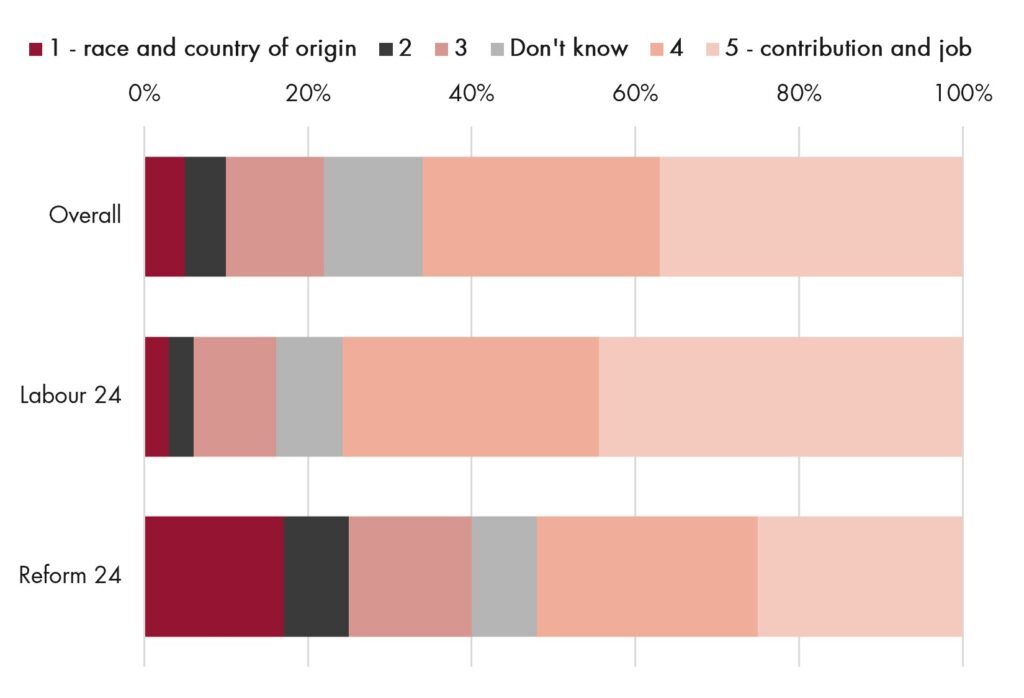
Question: When thinking about the government’s immigration policy, where would you place your views on this spectrum? 1 – the government should be mainly concerned with the ethnicity and country of origin for someone who comes to the UK and stays to 5 – the government should be mainly concerned with the ability to contribute and have a job for someone who comes to the UK and stays.
The public prioritise control, values and contribution
This polling suggests that most people do not share the Reform voters’ view that a successful migration system is defined by how low the headline migration figures can go, or by excessive toughness.
Instead, the average voter – including Labour voters – want the same thing. There is a migration middle ground centred on control, values, and contribution.
[i] All figures, unless otherwise stated, are from YouGov Plc. Total sample size was 3,031 GB adults. Fieldwork was undertaken between 25th – 27th August 2026. The survey was carried out online. The figures have been weighted and are representative of all GB adults (aged 18+).
[i] Around 27,900 people arrived across the channel in the year ending 9 September 2026. This compares to 31,5000 arriving via small boats in the year ending 5 July 2024.
[i] Trust is defined as selecting between seven and 10 when asked ‘on a scale of zero to 10, where zero represents ‘not at all’ and 10 represents ‘completely’, to what extent would you say you trust the following politicians to handle migration and asylum?’ Distrust is defined as those picking between zero and three.
[i] Those who selected one and two on the scale were deemed to support ‘the government should be mainly concerned with the ethnicity and country of origin for someone who comes to the UK and stays’, while those who selected four and five were deemed to support ‘the government should be mainly concerned with the ability to contribute and have a job for someone who comes to the UK and stays’.