Green Room
Miatta Fahnbulleh is right about everything. Will it matter? She talks to Iggy Wood about her plan for a green transition that benefits all
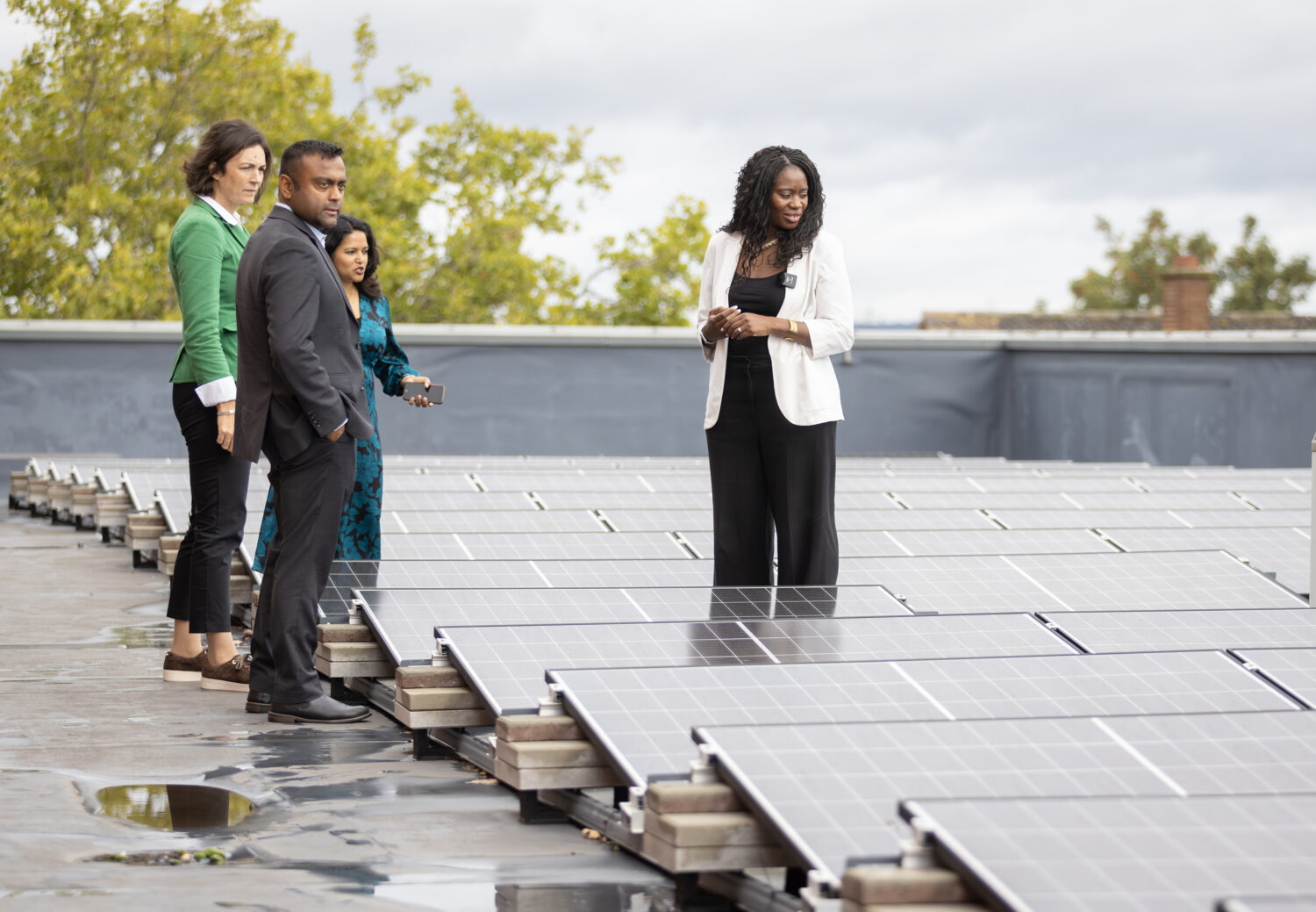
In the not-so-distant past, consensus around the need to tackle climate change at least superficially encompassed the entirety of British society. It was the historic party of capital – the Conservatives – who enshrined net zero in law, eliminated coal from Britain’s energy mix, and committed to ending the sale of petrol and diesel cars. Some of the most important progress was made under Boris Johnson, who, while not on the right of the party per se, was a Brexit-supporting populist.
Today, that same party wants to repeal the Climate Change Act, and its competitor on the right, Reform UK, is a hotbed of outright climate change denial. This is a disaster for climate policy in the UK, and places Miatta Fahnbulleh, the new energy secretary, on the political frontline. The shift has been, in her words, “frustrating, and quite sad.” She is quick to point out, however, that the political parties of the right have not brought the public with them. “If you look at all the polling, the majority of the public still support climate action. They are seeing… the impact it’s having on their homes, their businesses, and their communities, [and] they want to know the government is responding.”
Few people are as well-placed as Fahnbulleh to take the fight to the revanchists. Many politicians like to cultivate an intellectual persona; she is the real deal. She is so well-respected, in Labour circles and beyond, that she is already being touted as a potential future PM, which is quite something for an MP first elected in 2024. Yet the path from thinktanker to MP, while well-trodden, is also treacherous. Unlike their peers, ex-wonks are liable to be audited against an extensive record of their pre-Commons political beliefs. It will be difficult to embrace ideas as radical as those of her New Economics Foundation days.
Net zero’s opponents, including Kemi Badenoch, often use the UK’s relatively small contribution to present-day global emissions as a justification to row back on climate- friendly policies. Why punish ourselves, they ask, when our emissions are dwarfed by those of the US and China? This doesn’t wash with Fahnbulleh. “Of course Britain cannot solve climate change on its own; but every country could make that argument, and if everybody did, nothing would happen.” She also refuses to accept the premise that acting on climate change means punishing ourselves. “My job is not to ask people to make themselves poorer for the climate. It is to make energy cheaper, make Britain more energy secure and build the industries and jobs that are going to dominate the global economy in the coming decades.” If we get it right, Fahnbulleh says, the green transition can be a “double win,” as we “pump billions of pounds of investment into upgrading our economy, our homes, our buildings, our communities.” She is scathing of the Tories’ attempts to blame high energy bills on net zero rather than their own policies: “the Conservatives and Reform are trying to weaponize net zero and say ‘that’s the reason our bills are high,’ rather than the fact that they’ve been structurally unaffordable for a very long time. And I would put the roots [of that] squarely in privatisation and the failure to do it right.”
It is not only on the right that the consensus has broken down: two of the largest trade unions affiliated to Labour, GMB and Unite, recently intervened in favour of drilling the Jackdaw and Rosebank oilfields. Fahnbulleh maintains that the unions are taking climate change seriously, and defends their support of fossil fuel industry workers. “Their job is to represent working people, and they are absolutely right to ask hard questions about what the transition means for jobs pay, skills and communities. The challenge for the government is to make the transition something that working people have a stake in.”
The idea that the green transition will materially benefit British people is perhaps counterintuitive. It could certainly lead to cheaper power, and there may well be new jobs – but aren’t we deluding ourselves to think people in rich countries can continue living our consumption-oriented lifestyle? Fahnbulleh reflects that our lives are changing rapidly anyway, with or without government intervention, and cites the example of rooftop solar, which can lower bills by hundreds of pounds while lowering a household’s emissions, as an example of a lifestyle change that will not need to be imposed on people. This, though, seems like low-hanging fruit. What about meat, flights, and cars?
In the case of the latter, the zero-emission vehicle (ZEV) mandate – which will require 100 per cent of car sales to be ZEVs after 2035 – is set to make the single largest contribution of any policy to bringing down the UK’s emissions. Yet the government has announced it is reviewing the timeline according to which the mandate will be phased in. Fahnbulleh says this is because the world has changed since the Tories were in power. “No one is disputing the end destination. But I think it’s right that you’re always calibrating. The question that we’re basically asking people is: ‘we want to move in this direction, we’ve designed a mechanism to incentivise industry… [but] the world is much tougher today than it was when we first came up with this; what do you think?’
“The status quo position is still there, but we’ve given some other options. We will see what people say.”
Reopening the discussion – even if just to tinker – is not without its risks. Along with the rest of the world, we lag far, far behind China when it comes to electric vehicles. European carmakers have shown reluctance to embrace the technology; the state’s most powerful tool of persuasion is an inevitable future in which electric is the only game in town. The more uncertainty is introduced, the less inevitable that future gets. Fahnbulleh agrees that “stability is important.” She argues, however, that the government would be “pretty tin-eared” not to listen to the “whole host of stakeholders” asking the government to review the policy in light of recent developments – not least that the landscape of global trade has changed profoundly, with widespread supply-chain disruption and uncertainty around tariffs.
New technology will help us mitigate climate change, but artificial intelligence is one innovation which will likely make the task harder, not easier. Data released in April suggested that AI data centres in the UK could emit up to 123m tonnes of carbon dioxide – equivalent to the emissions of 2.7 million people according to the Guardian. Fahnbulleh says that it is a question of balance. While there is a “huge opportunity with AI and with data centres in terms of our economy,” she says, “we must do it in a way that is consistent with our environmental obligations.” All this could be a moot point, of course: data centres need cheap electricity, and our industrial electricity is among the most expensive in the world. Fahnbulleh thinks we can bring it down. “We are uniquely exposed to gas. France invested over decades in nuclear [through the] state-owned EDF… Norway invested in hydroelectricity and wind power. They diversified their energy mix, which means that they can keep their energy more affordable. We didn’t do that.”
Labour’s drive towards a more diverse energy mix was started by her close ally, Ed Miliband, who served as the energy secretary in the Starmer administration until that government collapsed – a process that Fahnbulleh helped initiate as the first minister to resign in the wake of May’s disastrous local elections. What was going through her head at the time? “It was a really difficult decision. When you are resigning, you’re resigning from a team. So it’s a really, really hard thing to do on a personal level.
“I’d spent a lot of time knocking on doors and talking to my constituents. And the message time and time again was completely consistent: they did not think that we were delivering the scale and the pace of change that they expected of the Labour government. I came to the conclusion that they were right.” Does she think the project was always doomed to fail? “No, absolutely not. I think there is a parallel universe where it looks very different.” The key problem, she says, is that the incoming government did not have a clear analysis of what was wrong with the country – but she disavows my suggestion that this was baked into the Starmer project. “I think it could have been developed by Keir, for Keir and it wasn’t.”
I worry that historians, 50 years from now, might look back and say “if only she had been there sooner.” It may be that Britain’s best energy secretary has been appointed at the worst possible time. She is hamstrung by a dysfunctional party unwilling to break cleanly from the most unpopular prime minister in history; an information landscape dominated by billionaires; and the path dependency engendered by 50 years of privatisation and inaction. Little wonder, in this context, that she is cautious at points; she won’t be drawn, for example, on whether renationalising water would really cost in excess of £90bn as Steve Reed suggested when he was the environment secretary (Moody’s, the ratings agency, suggests a figure of £14.5bn).
The science on climate change has long been settled. Now, at long last, the right person is in the right job. That a radical shift is not thereby guaranteed – that we might still see ourselves drilling for millions of barrels of oil, for example – raises fundamental questions about our party and our society. We must disavow Starmer’s mollifying tactics and level with people: things can only get better – but sacrifices will have to be made. The only remaining decision is who will make them.
Image credit: UK Government via Flickr, CC BY 4.0