Priced out
The rental market is failing renters - Labour should intervene to regulate rents, writes Marcus Johns

With the government laser focused on the cost of living, private rents should be a top priority to improve living standards. New polling for the Fabian Society by Focaldata finds that the public think England’s housing market is failing private renters, and that they expect the government to do more:
- 57 per cent of private renters say rent affordability is the single biggest problem facing renters, alongside 49 per cent of the public.
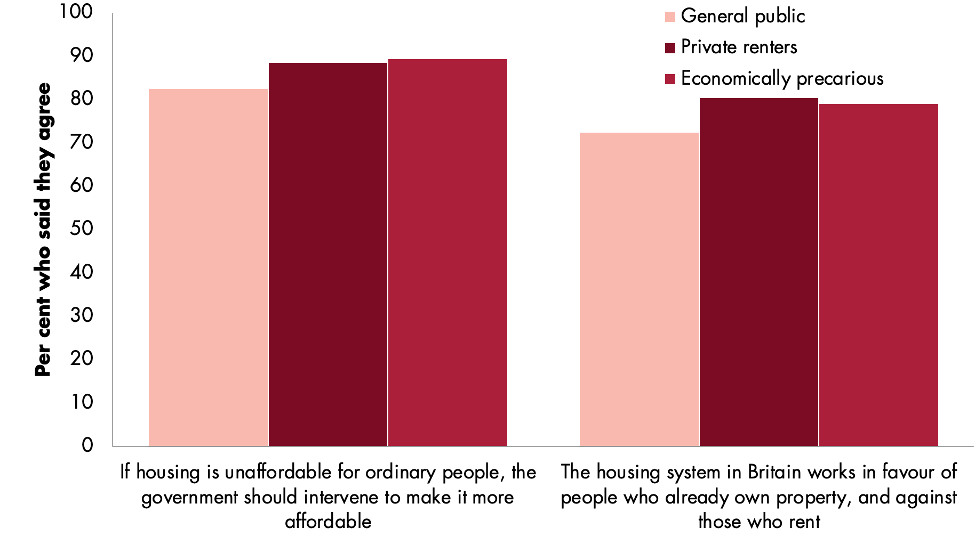
- 72 per cent of the public and 80 per cent of renters think the housing system is stacked in favour of those who own against those who rent.
- 80 per cent of the public and 85 per cent of renters say it is right for government to regulate when markets fail ordinary people, alongside over three quarters among every party’s voters, rising to 92 per cent of those who have switched away from Labour since 2024 and 90 per cent of those open to voting Labour.
England’s 12 million renters face significant financial pressure and insecurity. Recent analysis finds two in five of them spend more than 30 per cent of their income on rent and one in ten spend more than 70 per cent. Renters are highly exposed to economic shocks, and the OBR expects affordability pressure to worsen toward the end of the decade.
The cost of living remains the public’s top concern. In fact, nearly six in ten private renters (57 per cent) and nearly half the public (49 per cent) say rent affordability is the biggest problem facing renters.
In our polling, 88 per cent of renters say rising housing costs have an impact on their household, with one third describing this impact as major. This is a widespread issue, broadly consistent across England’s regions and social grades, and even more pronounced for economically precarious renters (39 per cent of whom say it has a major impact) [1].
As figure 1 below demonstrates, both the public and renters see this as an unfairness built into the system, 72 per cent of the public and 80 per cent of renters agree that Britain’s housing system works in favour of those who already own property and against those who rent — consistent across regions and broadly consistent across demographics.
[1] We define economically precarious voters as those who do not own their own home, have a household income below £40,000, and are aged 25-55, informed by recent analysis by JRF.
Figure 1: The public and renters believe that the system is stacked against them, and want intervention
Per cent who said they agree with the following statements.
The market alone will not fix this. First, it will take a long time for an increased supply of homes to affect prices and rents. The government is rightly seeking to boost supply, especially of social, affordable, and council homes. But renters are being squeezed now – affecting their living standards, making it harder to buy, and reducing spending in the economy. The impact of more homes on rents will take years – even decades.
Beyond supply, the private rental sector is not a functioning market. Renters cannot walk away from the need for somewhere to live, nor easily substitute one property for another when tied to work, a local school, or their community. They cannot compare every property, readily find data on rents actually paid locally, or bargain as an equal with a landlord, as a functioning market demands. Landlords are not disciplined by the market, but enabled to extract rents. This is why landlords are earning supernormal returns, far beyond what investing their capital productively would earn, incentivising extraction through property over real economic growth.
Pressure on renters intensified after the pandemic and the inflation that followed, but high rents relative to incomes are a longer-term structural problem. It traces back to the liberalisation of the private rental market and the end of rent controls under Thatcher. In a broken market, where prices are set by those with more power, renters are stuck in an affordability trap. Even raising renters’ incomes simply leads to landlords charging more.
The public know this. When asked what drives pressure on rent affordability, renters point to landlords charging as much as they can (36 per cent) almost as often as inflation (41 per cent) or wages not keeping up with rent (40 per cent) – all well ahead of the proportion who blame not enough houses being built (22 per cent). Renters in our focus groups corroborated this, with little confidence that building new homes would improve their lot.
The public want and expect government to step in. We asked if, when housing markets fail, it is right for the government to regulate to make it more affordable. 82 per cent of the public and 89 per cent of renters agree. Support tops three quarters among every party’s voters, reaching 92 per cent of those who have switched away from Labour since 2024 and 90 per cent of those open to voting Labour.
The government has already stepped up, passing the Renters Rights Act in 2025. This has strengthened security and quality, ended no-fault evictions and introduced a soft rent control by limiting rent increases to once a year and empowering tenants to challenge increases above local market rents. Together, they have led to a generational change, tilting the balance of power towards renters. As figure 2 below shows, our survey finds a hopeful mood for the Renters Rights Act, with renters and the public expecting it largely benefit renters with limited impact on landlords.
Figure 2: The public and renters expect the Renters Rights Act will largely benefit renters with little concern for negative impacts on landlords
Per cent of (general public or private renter) respondents saying the Renters Rights Act will make things better for particular groups, including those with little or no knowledge of the Act.
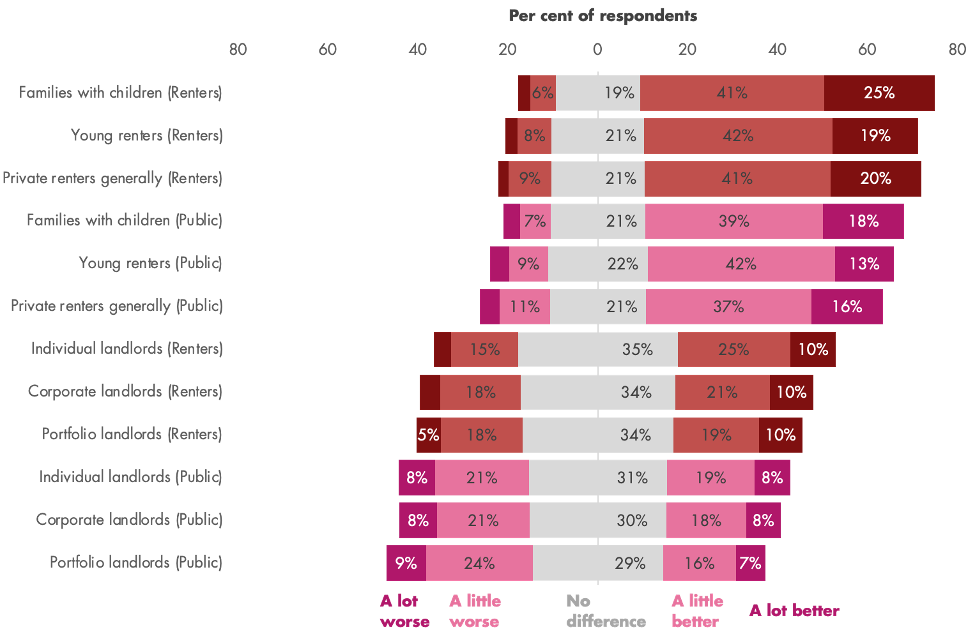
Expectations are modestly positive. Among those who have heard of the Act and know what it is, a quarter think it will make things a lot better for private renters and 36 per cent a little better. Among those who show high knowledge of the Act, when correct recognition of the Act’s measures is tested, 20 per cent say a lot and 45 per cent a little better. Around a fifth expect it to make no difference, including 19 per cent of those who know the Act and 17 per cent of those with high knowledge of its provisions.
The Act’s protections depend on tenants knowing and enforcing them despite awareness being limited. Only half of private renters (51 per cent), and a third of the public, say they have heard of the Renters’ Rights Act and know what it is, while 34 per cent of renters and 44 per cent of the public have heard of it but do not know what it does.
Renters also need confidence to enforce them. In our focus groups the rent tribunal was unknown and renters described real anxiety about challenging landlords, even for necessary repairs. Because market rents themselves remain unaffordable for millions, so-called economic evictions are still possible at a market level.
The Act is a good foundation, boosting renters’ rights with more security. However, given acute affordability pressures and with the public expecting action, it should be built on with measures to intervene on unaffordable rents.
Many countries similar to the UK have implemented various forms of rent controls, to provide renters with stability and security. For example, Germany, France, Ireland, and Spain all regulate rents in some form. The international evidence shows how important it is to design a good scheme to avoid negative impacts on housing supply. Some, poorly designed controls have reduced housing supply – particularly blunt caps applied uniformly regardless of local conditions. But well-designed, targeted models, including in Spain and Ireland have not paid this price. This shows that supply risk is a product of how the rent control is designed, not a necessary feature of regulation itself.
In a more regulated market, the onus to demonstrate compliance should be on the landlord. The government’s new landlord database can give tenants easier access to information and improve data for local and national policymakers. This should include rents paid, quality of homes, and facilities provided, as previously recommended by the Fabian Society.
For this more regulated market, the government should implement rent regulation, tailored to Britain’s housing market and designed to address the clear affordability pressure affecting renters. Soon, we will publishing further detail on what this could look like.
The cost of living crisis isn’t going away any time soon. The government will need to look at private rents if they want to improve people’s living standards.
Focaldata
Focaldata is a public opinion research agency and data collection platform. Focaldata combine cutting-edge sampling, survey methodology, and machine learning to measure what people think with accuracy and depth. Focaldata work with political parties, campaign groups, think tanks, charities, and public affairs teams to turn complex attitudinal data into clear strategic insight. Focaldata is a registered member of the British Polling Council (BPC) and Market Research Society (MRS).