Road to recovery
Wes Streeting has one of the toughest jobs in politics: putting the NHS back on track. He talks to Iggy Wood about Labour’s 10-year plan – and how he pushes for change from inside the cabinet
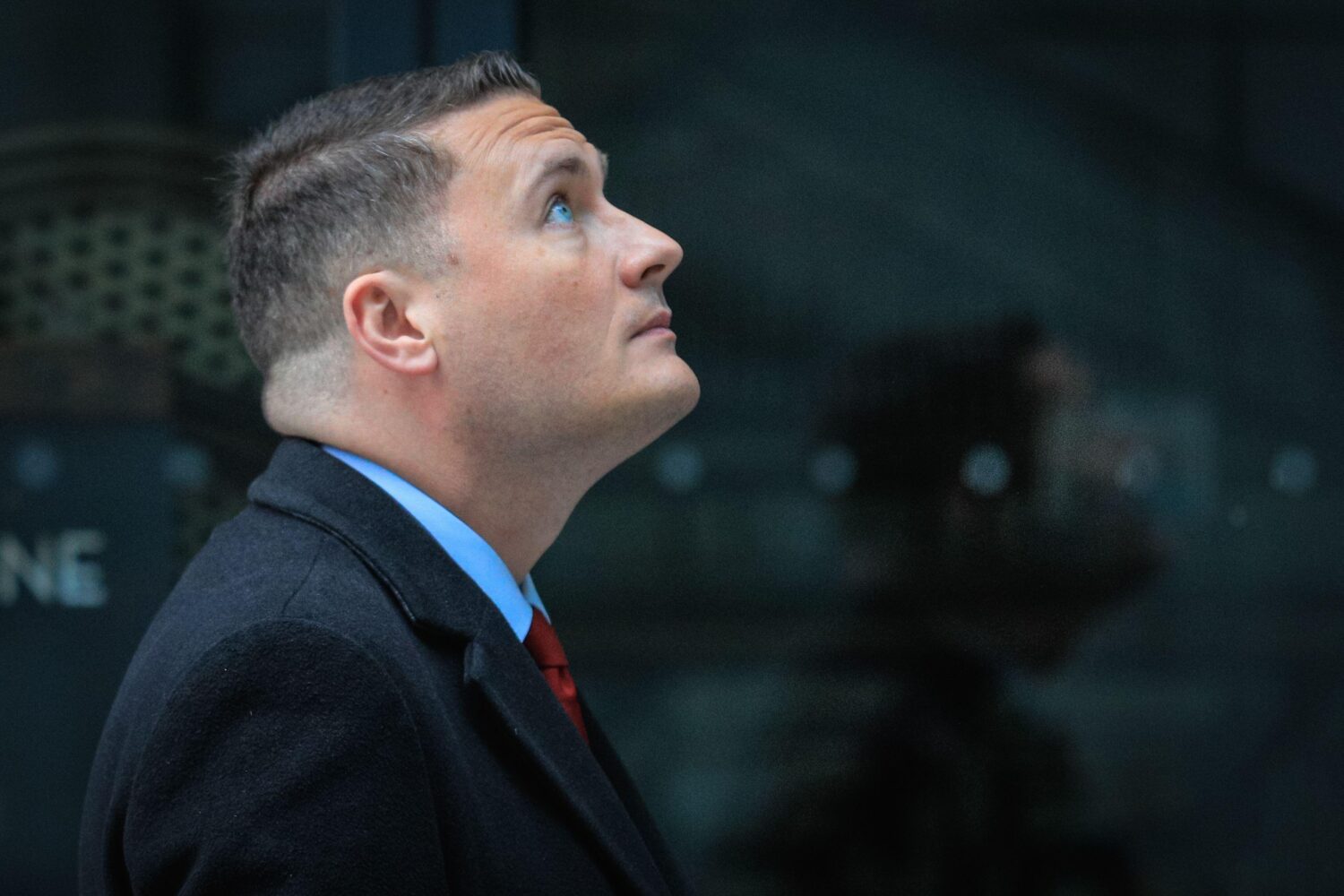
Politicians today often seem to exist at the whim of political winds; plankton variously transported and dispatched by forces beyond their control or comprehension. Wes Streeting, in contrast, has always had an air of intent.
This deliberateness is the now-rare mark of the true political heavyweight: you can already imagine reading his doorstop, mononymous political biography, STREETING. He has even had his obligatory brush with political disaster. In 2024, he won his seat only narrowly, coming in fewer than 600 votes ahead of Leanne Mohamad, an independent candidate who campaigned on a pro-Palestine platform.
The theme of the chapter about late 2025 will surely be conflict. On the one hand, Streeting has just secured a pharmaceuticals deal with the US after months of Maga grandstanding; on the other, the BMA has just announced more resident doctor strikes. Such substantive struggles have been supplemented by more farcical affairs – in particular, the briefing campaign launched against him, allegedly by Number 10 operatives, in mid-November.
All the while, Streeting is trying to deliver on Labour’s 10-year plan for the NHS, one of the most ambitious reform programmes in recent history. The plan sets out three shifts – from hospital to community; from analogue to digital; from sickness to prevention – which cumulatively promise to make the health service ‘fit for the future’.
Perhaps the most striking aspect of the plan is the self-described ‘big bet’ on AI, which offers the promise of significant productivity improvements. For Streeting, though, the question is not merely about efficiency.
“For me, this is a moment in the world’s history for which Labour politics are the answer.
“This a revolution that could work for the many or it is a revolution that could work for the privileged few. So this isn’t a ‘stop, start’ question or a ‘yes, no’ question. This is a classic ‘many, few’ question. Is this going to be a revolution that works in the interest of the many, or is this a revolution that’s going to work in the interest of the privileged few?
“We could play in the shallow end and say that this revolution is all about improving back-office processes and productivity and efficiency.
“We will absolutely do those things. In fact, I was looking at a pretty startling and encouraging stat: ambient voice technology used across nine London sites is freeing up 30 per cent of clinicians’ documentation time, which they can then spend on patient care.
“But what if we went a step further, and said: actually, this is about making sure that patients from working-class backgrounds like mine have the same ease and convenience… that people from privileged backgrounds can enjoy?”
Streeting sounds refreshingly political – ideological, even.
“I sort of feel at times… we can come across as the maintenance department of the country.
“The problem with presenting yourself [this way] is that someone else can easily come along say: ‘yeah, we can fix that, and we can do it cheaper’. We have to show that you can’t just pick any old political party to come in. You need to have a values-driven approach. And what we’re fundamentally driving at with a 10-year plan is what John Prescott would have called traditional values in a modern setting.”
While it may have started life as a New Labour formulation, the phrase ‘for the many, not the few’ is now fundamentally associated with the Corbyn project. Yet Streeting has riffed on it three or four times in the first five minutes of our conversation. Taken together with his recent comments at NHS England’s LGBTQ+ conference, at which he railed against racism and transphobia, and his recent congratulation of New York mayor-elect Zohran Mamdani, it’s not difficult to see why some people suspect he is ‘tacking left’ – a suggestion intrinsically linked to speculation around his leadership ambitions.
Apart from anything: if Mamdani were British, he would hardly be Streeting’s natural ally, would he? He grins.
“Zohran Mamdani didn’t stand on a platform of healthcare free at the point of use, which is my platform. So yes, I am to the left of Zohran Mamdani on that issue.
“More seriously, people might not always agree with me, but they do know where I stand… I am a conviction politician.
“I run into difficult arguments because that’s the job of political leadership: to make sure that you are helping the country through some of the thorny and difficult issues, not just on issues of cozy consensus.
“I have been bemused, to put it mildly, that people have seen some of the things I’ve said as kind of tacking one way or another. On Gaza, for example… I was calling for targeted sanctions against illegal Israeli settlements and the recognition of a Palestinian state when I was an opposition MP and Jeremy Corbyn was leader. And I don’t think anyone would suggest for a moment I was trying to ingratiate myself with Jeremy Corbyn.
“I [also] pushed hard as a member of the cabinet and as part of the child poverty taskforce for us to end the two-child limit, because child poverty is the single biggest issue I care about in politics.”
It must be tricky being a conviction politician as a member of the cabinet, though. What about people who say, for example: ‘You’re a member of a government that won’t call what’s been happening in Gaza a genocide. That’s a red line for me, no matter what your personal opinions may be’?
“I think there’s no doubt that Labour lost support at the last general election on this issue. I was very clear in advance of the general election that that was likely to be the case. I warned very early… in the shadow cabinet, that the rhetoric coming out of Israel’s leaders looked like a government that was preparing for the sorts of military activity that we would consider to be unacceptable and disproportionate, and far beyond reasonable self-defence or the targeting of Hamas. And so it’s come to pass. But I’m really proud of the fact that since we’ve been in government, we have led the way on recognition of a Palestinian state, and I think the UK deserves some credit for the international leadership we’ve shown on this issue.
“There are certainly people to our left who want to use this issue as a wedge issue and strike a radical pose. I’m more interested in making sure that we can build a just and sustainable and lasting peace. And there is a difference between the language of the protester and the language of the diplomat.
“I know which of the two gets the most done, so while I have enormous respect for people who have been out either protesting or fundraising on this issue, who have done so peacefully and within the law, I also think that ultimately, the prime minister and David Lammy have done an awful lot of diplomatic heavy lifting that has helped us to get to where we are today, which is a ceasefire, and the glimmer of hope for peace.”
Diplomacy is one thing, but what about leverage? What about sanctions?
“We’ve sanctioned members of the Israeli government. We have sanctioned Israeli settlers. We’ve enforced arms export controls. So I don’t think… you know, this government has taken real action, and that is not without controversy, and it’s not without cost… but I think we’ve ultimately done the right thing.”
Gaza is not the only issue presenting Labour with a challenge from the left. Streeting is a particular target of anger over the government’s attitude towards trans rights. Does he see why some trans people were expecting more of a shift when Labour won power – and now feel betrayed?
“Yes, bluntly. [I understand] how people in my community feel because for most of my lifetime, LGBT equality has moved in the right direction. We have become more inclusive as a country, we have become more accepting as a country, and particularly the last Labour government changed laws, hearts and minds.
“It felt like things were moving in the right direction, and then suddenly, arguments that we thought had been won are now being contested. And trans people are at the wrong end of a whole number of statistics in terms of hate crime, mental ill health and discrimination. And I can understand why, when a Labour health secretary came in and upheld a ban that was put in place by his predecessor on puberty blockers, trans people would have kind of stopped and thought: ‘is this government one that is supportive of and inclusive of trans people?’
“While I understand that, I have absolutely no regrets at all that it was the right thing to do. I have to act on the basis of clinical advice… and what I think is most shocking about all of this is that for many years, puberty blockers have been prescribed to children for gender dysphoria without sufficient evidence, without good clinical trials, and with potentially detrimental longer-term consequences for their health, and I find that shocking.”
To the fury of the Telegraph’s gender studies desk, a clinical trial led by scholars at King’s College London is now scheduled to take place. It has been welcomed, if a little guardedly, by Hilary Cass, the author of the report which prompted the ban. Cass placed a lot of emphasis on double-blind, randomised controlled trials as the gold standard of evidence. The KCL trial is not one of these – for pretty obvious reasons, if you think about what a double-blind trial for puberty blockers would look like – but it is large-scale enough, and carefully designed enough, that it could win over some sceptics.
“Now… I’m receiving a huge amount of criticism from people who supported me on the original ban, and think that the trial is the wrong thing to do.
“I don’t mind saying that I am uncomfortable with this… I do think, for what it’s worth, that… the clinical governance and the thought and effort that’s gone into the clinical trial will make it extremely robust, with the welfare and wellbeing of children at the heart of it. But I’m not entirely comfortable about it.”
One of the most striking statements in the 10-year plan is that the NHS must ‘reform or die’, a phrase that has met with accusations of alarmism. Streeting, however, disagrees.
“When I say the NHS needs to reform or die, I’m not presenting that as an agnostic, offering a neutral choice. I want the NHS not only to survive, but to thrive, and the values of the NHS to thrive, in the 21st-century.
“The Reform party make no bones about the fact they want to see an insurance-based system. They don’t believe in the NHS. You’ve got Kemi Badenoch, as well, saying we need a debate about the funding model. So this is now seriously contested for the first time since the Tories voted against the foundation of the NHS 22 times and the BMA marched against it.
“It’s all right for Nigel Farage – Mr. Money Bags can afford to pay for insurance. But most people in this country cannot.
“I think it is an amazing thing that I had one of the world’s best surgeons and cutting-edge technology to do my kidney cancer treatment, and at no point, with all the other things I was worried about, did I ever worry about the bill.
“There’s a fun selection of Green party and Your Party memes that suggest I want to privatize the NHS. Over my dead body. I believe in the NHS as a publicly-owned public service, free at the point of use.”
The missing link here, though, is money. Right-wingers love to talk up the advantages of social insurance systems in France and the Netherlands, which now boast better results than the NHS across a range of criteria. The truth, however, is that these countries just spend a lot more per person. And as far as I can gather, the rough consensus from the health sector is that the 10-year plan is an excellent, ambitious document, but one which may not have the resources to make it a reality. Can we ever hope to compete with, say, France – which spends about 26 per cent more on healthcare per capita?
“We are investing more, but we’ve also got to modernise, and that’s why you’ve got to do investment and modernization to get the results. That’s at the heart of the 10-year plan.”
But surely he would like more money – especially in the context of striking resident doctors?
“If the public finances are tight, which they are, the NHS will always be a priority for a Labour government, but modernisation is having to do more of the heavy lifting.
“I would also say, though, that even if the chancellor found billions down the back of her sofa, we can’t just spend our way out of this crisis.
“The Tories threw lots of money at the NHS without results. The last Labour government did investment and modernisation and delivered the shortest waiting times and the highest patient satisfaction in history. So that’s the approach that we’re taking.”
New Labour’s health secretaries had more than 2.4 per cent annual spending growth to play with, though, didn’t they?
“People shouldn’t underestimate the scale of what we’re trying to achieve here. I’m trying to deliver performance improvement on a scale exceeding New Labour at the height of their success with not as much of an improvement in spending power from year to year. But we are doing it.
“Waiting lists are coming down for the first time in 15 years. We have a reform plan for waiting times… I believe [we] will achieve 18 weeks by the end of this parliament in terms of waiting times, down from 18 months when we came in. [This is] at the same time as improving access to general practice, improving services at the touch of button via the NHS app, rebuilding NHS dentistry and improving mental health services. We will not have it all done over the course of [this] parliament, but I want to be able to go into the next general election showing that the NHS is well down the road to recovery and asking people to give us a chance to finish the job, rather than hand the keys to Reform to crash the car.”
It is strange that Streeting’s eloquence is deployed against him – often being used to suggest insincerity. To my mind it’s just the opposite: it is much easier to speak fluently when you’re expressing your opinion rather than having to remember what your opinion is meant to be. In other words: it’s hard to fake a worldview.
Streeting’s moderation is not a product of triangulation; he’s just a moderate. The question, then, is not what sort of a politician Wes Streeting is. There is no enigma to unravel, and far less 4D chess being played than by some of his ‘soft left’ counterparts. It is whether the sort of politician he is – a new public management-influenced, liberal, modernising social democrat; a Third Way true-believer – is compatible with the unforgiving environment of 2020s Britain.
Image credit: © Imageplotter/Alamy Live News