False idols
Liam Byrne's new book highlights the internal contradictions of the populist movement, finds Paul Richards

Populism, says Byrne, is like pornography – hard to define but you know it when you see it. We see it all around us. It appears on our phones as pulsating, algorithmic anger. It is pumped through the airwaves by enraged grifters, peddling monetised hate. It flutters from the lampposts in the form of the tatty Chinese-made polyester union flags that mock true patriotism. It finds form at the ballot box as millions vote for weirdos who count the number of Black people in adverts, bank Moscow gold, and revere a woman jailed for wanting to set fire to kids. Hard to define, but the soundtrack of our age.
The issue, as Byrne says, is not merely to understand the wave of populism crashing up against our assumptions, institutions, and way of life. It is to tackle it and take it down. This is not easy. Populism thrives on discontent and division. It feeds on mawkish nostalgia and loss of a golden age. It speaks to deep emotions and dark fears.
The crash, Brexit, Covid, Ukraine – these things have created real hardship and dislocation. Wages have flatlined, high streets have hollowed out, neighbourhoods have been transformed by the ‘Boriswave’, and AI is coming after our jobs. This deep-seated unease is what populism both feeds off and fuels. As Byrne says, we are living through an age on unparalleled population movement, technical revolution, and a once-in-five-hundred-years shift in global power from west to east and north to south.
Add to this a populist playbook pioneered by a felonious, mendacious half-wit who has tapped into America’s dark side and created a formidable electoral bloc. The soon-to-be-ex president of the United States offers hope to every kleptocratic, emotionally-stunted, women-hating sociopath who might want to run a major economy.
And not just the would-be Trumps. There’s the growing chorus of Trumpettes who recognise there’s easy money in clicks and shares, with rage selling well at the box office. Take the cashola Matt Goodwin is making from his AI slop offering Suicide of a Nation, overflowing with as much rubbish as a Birmingham bin. Why bother to check quotes, sources or facts? The idiots will lap it up regardless.
Byrne’s solution is to emulate Franklin Roosevelt in similar times of discombobulation. As the banks were collapsing, businesses closing, and brokers were raining from skyscrapers, Roosevelt declared what America had to fear was not the media, the Jew, the elite, the politician, the ‘other’. No: what America had to fear was fear itself. And he set about creating jobs, building dams and bridges, and marshalling the awesome resources of the state to put his nation to work.
And this is perhaps the most important point to take from Liam Byrne’s impressive, fresh, and well-crafted argument. The answer to a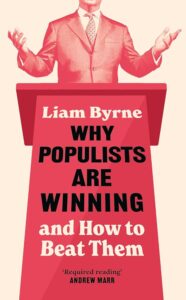 populism of the right is not a populism of the left, swapping one set of scapegoats for another. It is instead to offer hope instead of fear, just as Roosevelt, Obama, and Blair did. To appreciate patriotism and place, and to steer them in positive ways, reviving town centres rather than daubing roundabouts. To understand the impacts of the mass movement of people, and not to dismiss real fears of dislocation. To choke off foreign funding for the populist parties polluting our democracy with anti-British sentiment. To make government work, rooting out waste and inadequacy, and reuniting our taxes with notions of the public good. To make democracy function for the demos.
One of the very few public intellectuals or thinkers that Byrne doesn’t quote is Noberto Bobbio, the Italian liberal theorist. At least I think he doesn’t; annoyingly, there is no index. Either way, back in the 1980s, Bobbio spoke of the ‘broken promises’ of democracy: oligarchies and elites persisting; power remaining opaque; interest groups prospering; an uneducated citizenry; democracy’s failure to take hold in wider society and the workplace; and technocrats and ‘experts’ trumping ordinary citizens.
Each of Bobbio’s broken promises reappears in our own times – on steroids. So, the task is simple but mighty: build a vibrant democracy, an economy which shares wealth, and put populism back in the box labelled ‘weird and irrelevant’. Liam Byrne’s book, well-written, skilfully-argued, and supported by new research, offers us another useful tool to do the job.