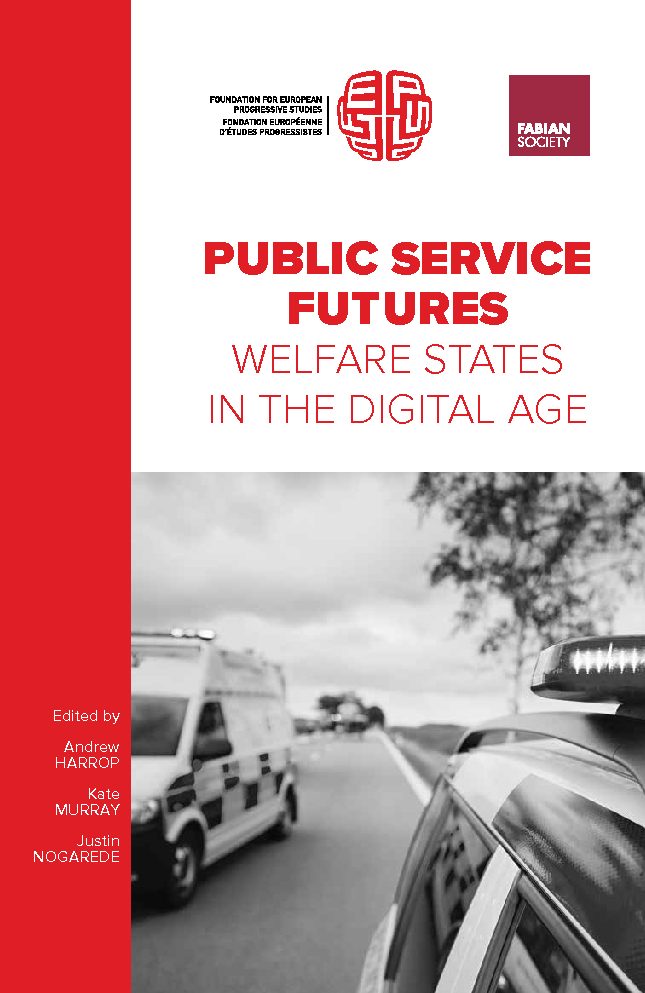
- Public Service Futures
- Andrew Harrop , Kate Murray
- 20 April 2020
- Public Services , Democracy , Technology
Public services across the UK and Europe have faced profound change in recent times as a result of spending pressures, market reforms and the impact of digital technologies. They will need to adapt to further challenges still, not least the increasingly urgent need to tackle the climate emergency. How can our welfare states become smarter at providing good services? How can they ensure a voice for all citizens? And how can they best innovate without losing their ethos?
In this collection, contributors from across Europe and the UK set out some answers to these questions. Their essays offer an insight into how the 2020s can be a time of great possibility for public services, with huge potential for new technologies to meet our shared needs and strong public interest institutions working in collaboration not competition.
This publication was supported by a grant from the Dartmouth Street Trust.
Editors


Our publications
View All
Building skills
This report examines the workforce and skills crisis facing the sector, with a particular focus on both the construction industry and engineering and building services trades. It sets out key policy recommendations to address the crisis and outlines ...
Read more
Status critical
Drawing on three focus groups with freelancers, gig economy workers and other self-employed people, Luke Raikes and Morgan Bestwick investigate the specific problems with employment status and set out a roadmap for addressing the most pressing issues...
Read more
Common Endeavour
In this series of essays, Labour MPs from across the ‘broad centre’ of the party set out how Labour can apply its values to the problems we face in the second quarter of the 21st century. The collection centres around four generational challenges: af...
Read more
Uneven ground
In this pamphlet, drawing on British Election Study data, James Prentice examines why Labour has struggled to hold together its 2024 coalition and sets out how a new progressive coalition can be built.
Read more
Pressing Reset
Rejoining the EU is not an immediate prospect. But in an increasingly uncertain world – and with public opinion in favour of greater cooperation – now is the time to revisit our relationship with our European allies. This collection brings together e...
Read more
Care to Share
In this pamphlet, which features a foreword by the former secretary of state for health and social care, Wes Streeting MP, experts and policymakers identify the decisions the government will need to get right to build a National Health Service.
Read more
Housing the future
This report sets out how the next Scottish government should use its powers to deliver a significant increase in housebuilding rates and tackle high housing costs. It analyses the main impacts of the housing emergency, and examines why Scotland hasn’...
Read more
Adopt, innovate, transform
Drawing on survey data and insights from three focus groups, this report examines the challenges civil servants face in shaping the government’s AI agenda. It sets out five priorities to help address these challenges and unlock the full potential of ...
Read more
The people's pools
Published in June 2026, amid record-breaking temperatures, this pamphlet aims to create tangible community assets, strengthen local democracy and “pride in place,” and give Labour a modern equivalent of one of its most iconic historical achievements.
Read more
Forward Planning
This report sets out how the government can ensure that owner-occupiers are able to age well in their own home. It identifies the scale of the challenge faced by older owner-occupiers, the barriers to improving housing, and the case for action. The r...
Read more
Whose Capital?
Featuring a foreword from Liam Byrne MP, this report sees Catherine Howarth make the case for stronger member representation and greater transparency across the pensions system. She sets out proposals for rebuilding trust in pension institutions and ...
Read more
Pathways to apprenticeships
The government is seeking both to reverse the dramatic decline in young apprentices seen over the last decade and to reduce the number of young people who are not in employment, education or training. Strengthening pre-apprenticeship pathways could h...
Read moreFabian membership
Join the Fabian Society today and help shape the future of the left
You’ll receive the quarterly Fabian Review and at least four reports or pamphlets each year sent to your door
Be a part of the debate at Fabian conferences and events and join one of our network of local Fabian societies
Join the Fabian SocietyBe the first to know
Sign up to the free Fabian Society newsletter
Find out about the latest Fabian Society research, publications and events with our regular updates
Sign up today